 Image 1 of 1
The Story of Money
Money has been made from almost everything imaginable. Before coins and paper, people traded shells, beads, furs, crops, tools, livestock, and other useful goods. Cowrie shells became one of the most widespread forms of shell money because they were durable, portable, difficult to fake, and naturally attractive. They circulated across parts of Africa, Asia, Oceania, and even North America.
Then we decided shells were too easy to carry and invented giant stone money. On the island of Yap, enormous circular rai stones could weigh hundreds of pounds or be as large as a car. Some were so heavy they never physically moved when ownership changed — everyone simply agreed who owned the rock. In other words, people were doing “digital banking” centuries before computers; the database was our memory, fortunately before Alzheimer’s took over.
Gold and silver changed everything.
Early coins appeared around the sixth or seventh century BCE in places including China and Lydia. Lydian coins were made from electrum, a naturally occurring mixture of gold and silver. Unlike a cowrie or a cow, a standardized piece of precious metal could carry a large amount of value in your pocket without needing to be fed.
Gold became prized because it is scarce, beautiful, workable, and remarkably resistant to corrosion. Silver was more abundant and became the everyday monetary workhorse for centuries.
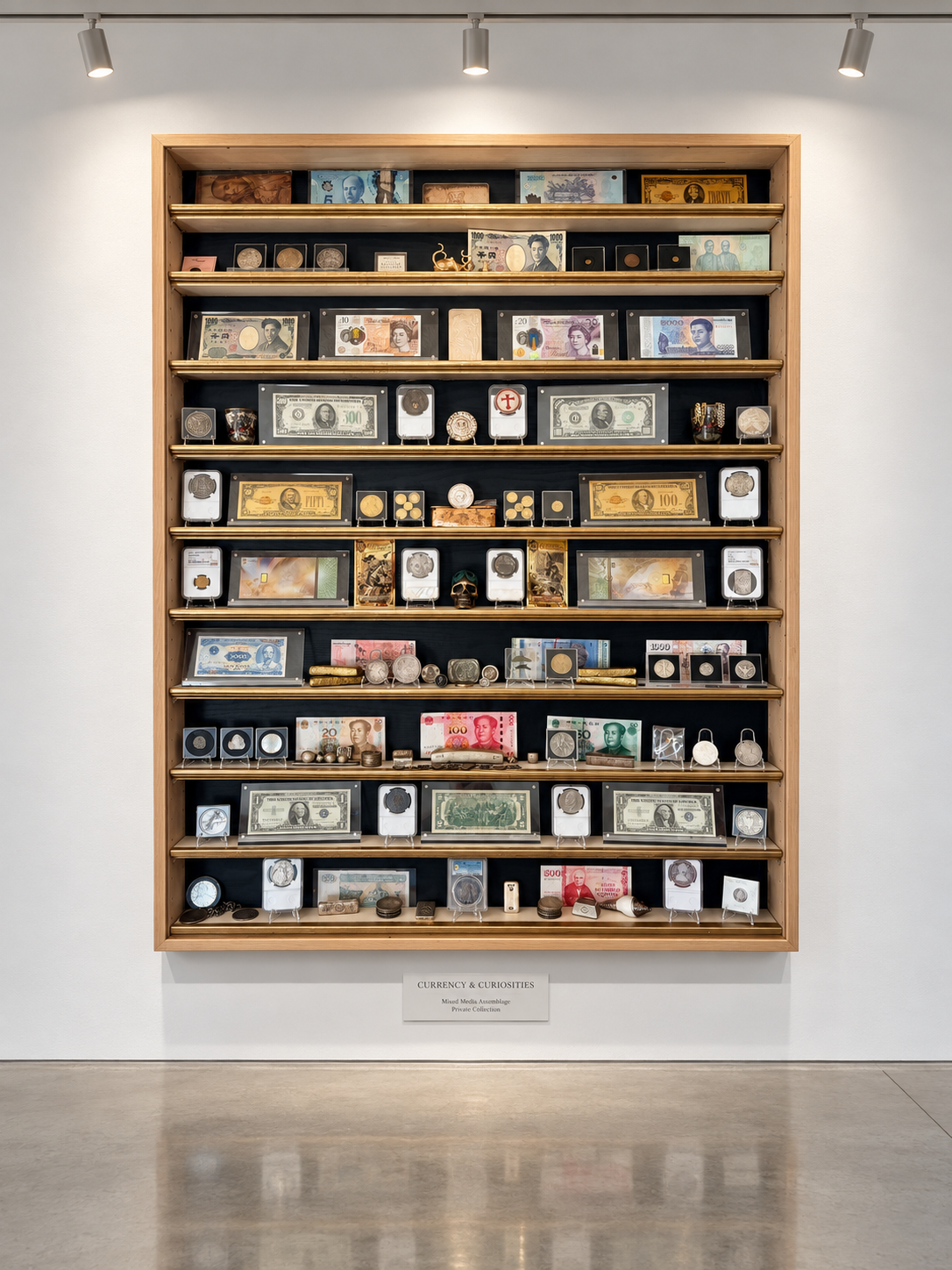
While my pirate-era coins are fascinating to me, the more remarkable coins are the early Greek/roman staters representing the very first Olympic Games. One is displayed here that’s over 2500 years old- imagine the story this one coin could tell.
Today we manufacture billions of coins and medals mechanically; an ancient Greek coin was individually struck with a hammer.
Ancient Greek cities often placed gods, athletes, horses, wreaths, stadium imagery, or local symbols on their coins. Coins associated with Olympia are especially fascinating because the ancient Olympic Games were not just athletic contests—they were religious festivals held in honor of Zeus. Victors competed for prestige rather than cash prizes, and the famous olive wreath became a symbol of honor.
Greek Olympic coinage also shows how sophisticated ancient minting had become. These coins were struck by hand between engraved dies, so no two impressions are exactly alike. A slightly off-center image, uneven edge, or strong strike can actually be part of the coin’s character rather than a flaw.
But ohhh “the Spanish silver eight reales, and gold doubloons”— or the famous “piece of eight.” Spanish dollars circulated throughout the Americas and Caribbean and were familiar money in colonial America long before the United States had its own national coinage. They could even be physically cut into pieces to make change — hence the expression “two bits” for a quarter of a dollar.
Pirate money wasn’t entirely Hollywood.
Those “pieces of eight” really were the international money of the maritime world. Silver mined in the Americas traveled aboard treasure fleets to Europe and across the Pacific to Asia. When one of those ships sank, the coins could remain underwater for centuries.
That’s what makes a genuine shipwreck coin so compelling: the coin itself traveled through the economic system that built empires, financed wars, paid sailors, bought cargo — and occasionally ended up on the bottom of the ocean.
Paper money isn’t really paper.
American dollar bill is 75% cotton and 25% linen. It contains tiny colored security fibers and, on denominations of $5 and higher, embedded security features such as threads and watermarks.