
 Image 1 of 1
Secrets of Seashells
Shells have clothed kings, carried money, been made into tools and weapons, sounded ceremonial and battle calls, fastened clothing, decorated jewelry and shoes, produced rare pearls, and even created one of history’s most valuable colors. Long before shells became souvenirs, they were used as currency, technology, medicine, building material, status symbols, and works of art. A seashell may look like a quiet souvenir, but its story can be anything but quiet.
Some shells are beautiful because of their color or shape. Others are remarkable because of what the living animal could actually do.
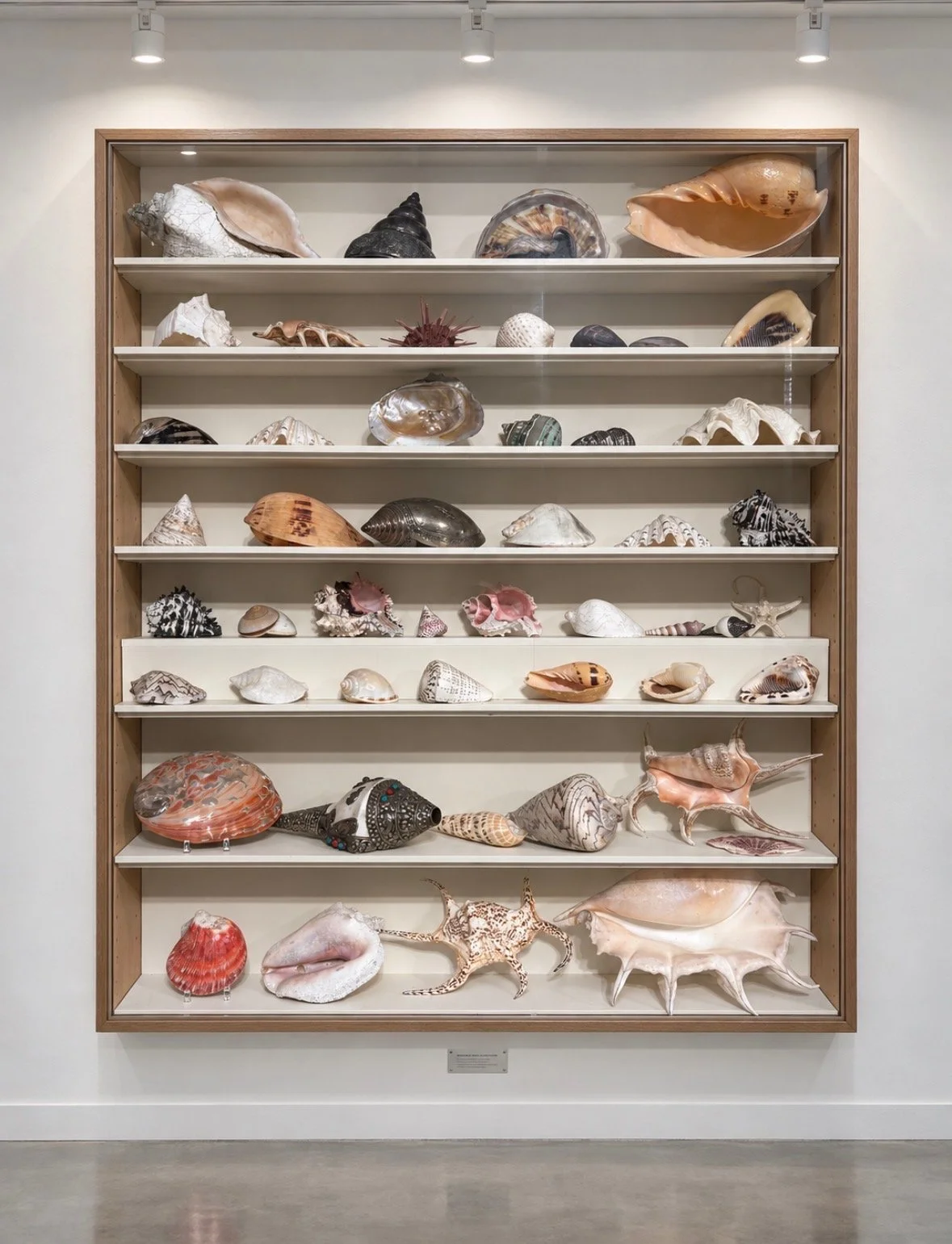
Cone snails are predators armed with a hollow, harpoon-like tooth. They fire it into prey and inject venom; some fish-eating cone species can be dangerous to humans. Cone snails also occupy an enormous depth range: many live in very shallow reef water, while some species have been recorded down to roughly 1,000 meters (3,300 feet). The textile cone can reach about 6 inches long.
The elaborate murex shells have a completely different claim to fame. Certain murex snails supplied the secretions used to create Tyrian purple, one of the ancient world’s most prized dyes. Producing even a small amount required huge numbers of snails, helping make purple a symbol of wealth and royalty.
The shell world gets much bigger still. The giant Australian whelk, Syrinx aruana, produces the largest known snail shell, reaching about 70 cm — nearly 28 inches — and living from intertidal water down to around 50 meters (164 feet).
Cowries are among the most historically important shells in the world. One species, the money cowrie, was used as actual currency and a measure of wealth across parts of Africa, Asia, and the Indian Ocean region for centuries. The same species also occurs in Hawaiian waters, giving this small glossy shell a remarkable story that stretches from tropical reefs to ancient marketplaces.
Pearls are created by shell-making animals. Oysters, mussels, clams, and even conchs can produce pearls, although not all pearls are the same. Classic oyster pearls are usually made of nacre, while conch pearls are non-nacreous and are prized for their pink color and distinctive flame-like pattern. In a way, a pearl is the mollusk using the same basic mineral-building machinery it uses to make and repair its shell—only forming a gem inside the animal instead.
There is also a darker freshwater story. Certain freshwater snails act as intermediate hosts for the parasites that cause schistosomiasis. The snails themselves do not attack people; instead, parasite larvae released into contaminated freshwater penetrate human skin. The World Health Organization currently estimates about 14,353 deaths worldwide each year from schistosomiasis, while noting that the real number is probably higher.
My favorite and perhaps the king shells, even though the king conch’s are actually poisonous, is the large pink-lipped queen conch. It has another remarkable secret. It inhabits Caribbean and western Atlantic shallows, commonly in water less than about 100 feet deep, and can grow to roughly 12 inches long and live for decades. As previously mentioned yet very rarely, maybe one out of every ten thousand create a gem conch pearl. — natural, non-nacreous pearls that form inside the animal and can display beautiful pink, peach, cream, or white coloring, sometimes with a distinctive flame-like pattern. Because they are uncommon and cannot be cultured in the same way as traditional oyster pearls, fine conch pearls are highly prized by collectors and jewelers. The Queen conch is unique as one shell can represent food, music, Caribbean culture, natural history, and one of the rarer gems produced by a mollusk. “At one point, I owned one of the largest documented conch pearls in the world — a specimen weighing roughly 125 carats — before eventually selling it to a guy who actually flew me into New York to make the offer”.
“Even discarded shells have value. Because they are rich in calcium carbonate, shells have been burned and ground into powders for centuries—used in traditional medicine, lime, building materials, soil treatments, and modern industrial products.”
But these, well, they are now just: shelve-fish!