 Image 1 of 1
Swords of the World
Being a pirate at heart, I’m a big fan of cutlasses, but there are so many varieties of swords, and for good reason.
Who Carried What?
Swords were shaped by the people who used them. Pirates and sailors favored short, heavy cutlasses that were easier to swing on crowded decks. Cavalry soldiers carried curved sabers designed for slashing from horseback. European knights used broadswords and longswords for armored combat, while duelists and gentlemen later carried slimmer rapiers and smallswords. In Japan, samurai wore the katana, often paired with a shorter wakizashi. Naval officers and military commanders continued wearing swords long after firearms took over the battlefield, turning the sword from an everyday weapon into a symbol of rank, honor, and authority.
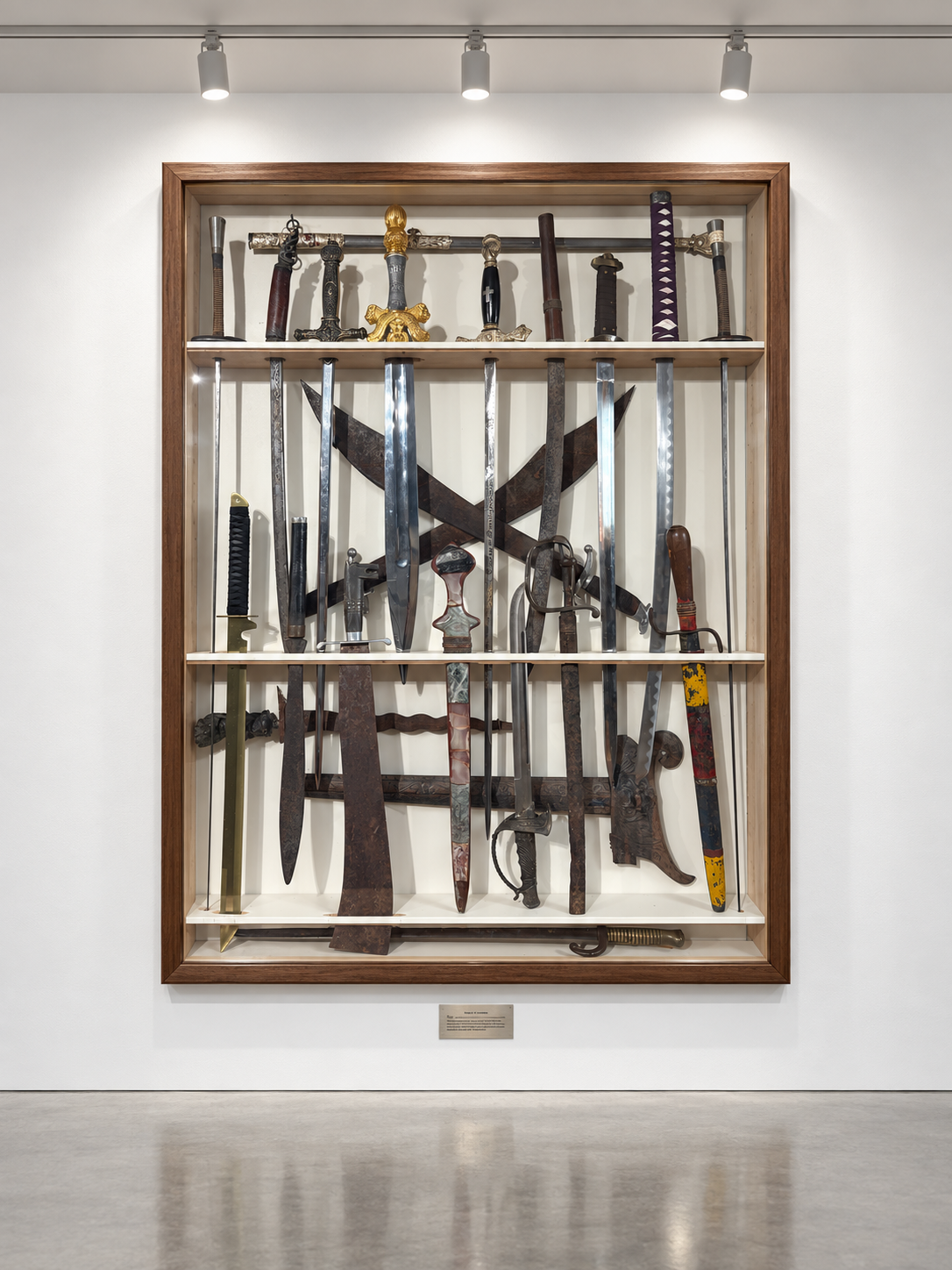
This is my most original and unique collection as I started building this assemblage while sailing around the world on a semester at sea. As we literally circumnavigated the planet, I seemed to find a sword in every country or port of call: a samurai sword in Japan, a cross in Malaysia, a be-header in India. But the prize of this particular collection came from an antiquity store in Jerusalem, where I bought an ancient Roman sword also displayed in this case.
What would Hollywood have done without the sword? The Great duel between Wesley and Inigo Montoya in The Princess Bride, Excalibur, King Arthur, Zorro, Star Wars, Gladiator, Kill Bill, The Three Musketeers, Conan, Robin Hood, and let’s not forget Pirates of the Caribbean! Swords have remained one of cinema’s favorite symbols of heroism, revenge, honor, and adventure. Even the lightsaber is really a futuristic sword—the ancient weapon reinvented for another galaxy.
For thousands of years, the sword was one of the clearest symbols of power. Before firearms dominated battlefields, a sword could be a soldier’s weapon, a nobleman’s badge of rank, a ceremonial object, and a work of art all at once. The earliest swords were cast in bronze, but the shift to iron and then steel changed everything. Steel could be made harder, sharper, and more resilient, allowing blades to become thinner, longer, and more sophisticated.
Different cultures solved the same problem in different ways. European swords often emphasized straight, double-edged blades designed for cutting and thrusting. Middle Eastern blades became famous for curved forms such as the shamshir, optimized for slashing from horseback. In Japan, the samurai sword — especially the katana — became one of the most celebrated examples of blade craftsmanship in history.
Japanese swordsmiths worked with tamahagane, a traditional steel made from iron sand, and repeatedly refined and forge-welded the metal to control carbon content and remove impurities. The blade was then differentially hardened, creating a very hard cutting edge and a tougher spine. That process produced the visible temper line known as the hamon. A fine katana was not merely a weapon; it could be an heirloom, a spiritual object, and a sign of samurai identity.
European blades had their own advanced metallurgy. Medieval smiths used techniques such as pattern welding, combining different iron and steel bars to create both strength and distinctive surface patterns. Later, high-quality crucible steels from India and the Middle East became associated with the legendary look and performance of Damascus steel.
Before dependable firearms, swords remained important because they were reusable, portable, relatively quick, and effective in close combat. Even after guns appeared, early firearms were slow to load, inaccurate, and unreliable, so soldiers still carried swords, sabers, cutlasses, and bayonets for centuries.
Swords also became highly specialized. Rapiers emphasized thrusting and civilian dueling. Sabers were curved for cavalry. Cutlasses were short and heavy for fighting aboard ships. Claymores and other large two-handed swords sacrificed speed for reach and power. Small swords became fashionable status symbols. Naval officers, cavalrymen, and military commanders continued wearing swords long after guns had taken over most combat.
And the sword’s symbolic life may be even bigger than its military life. Swords appear in coronations, religious ceremonies, coats of arms, military dress, mythology, and literature. They represent justice, authority, courage, sacrifice, and honor.