 Image 1 of 1
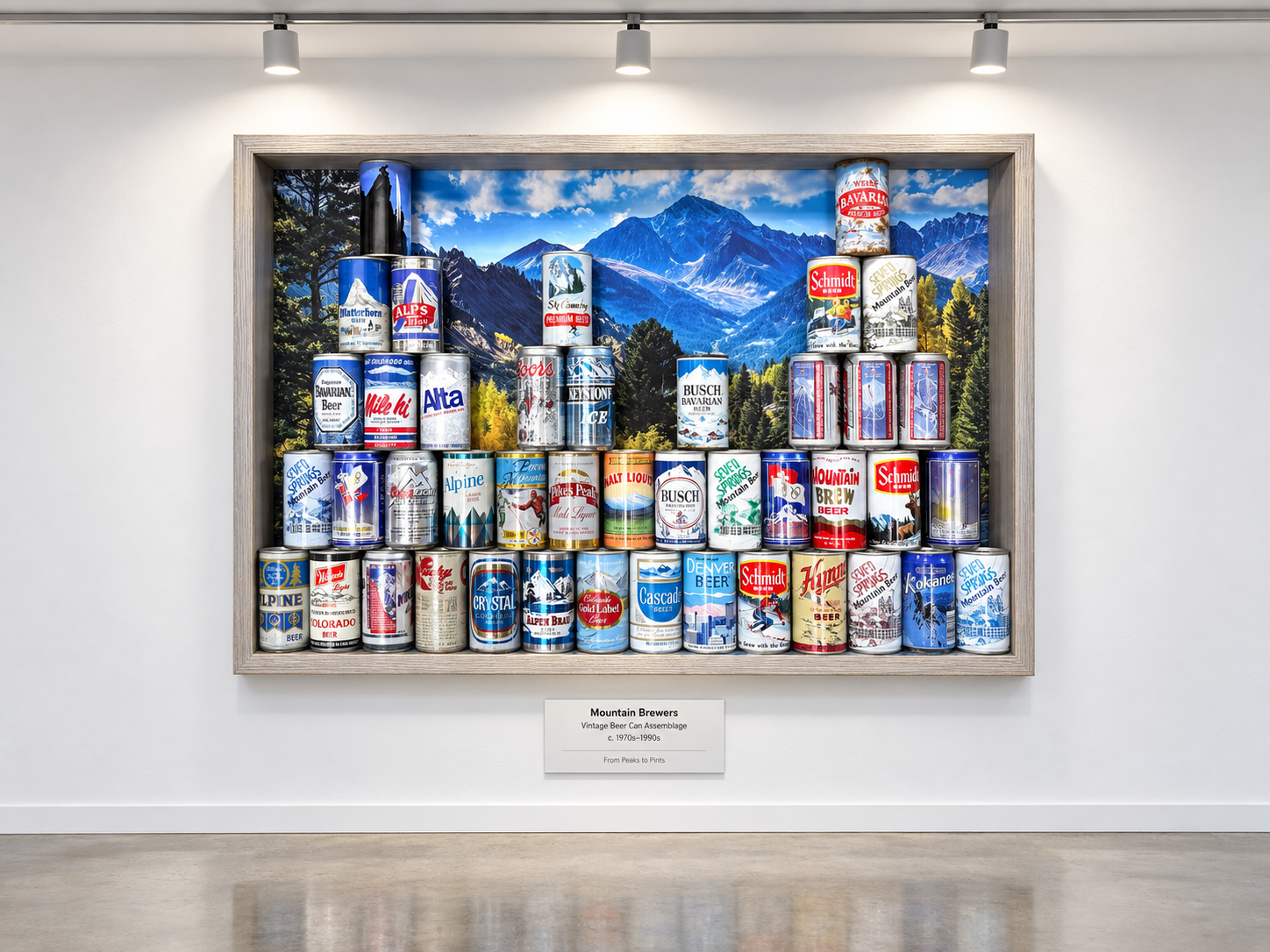
Mountain Beer Can Collection of the Alps
More than 1 billion beverage cans are produced every day. In the US alone, 115 million beer cans are shipped every day.
Beer is one of humanity’s oldest manufactured drinks. Long before cans existed, ancient societies in Mesopotamia and Egypt were already brewing fermented grain beverages thousands of years ago. Beer was food, drink, wages, ritual, and social glue. Centuries later, European brewing traditions — especially German lager brewing — profoundly shaped American beer culture through immigrant communities in places like Milwaukee and St. Louis.
Then came Prohibition. When national Prohibition took hold in 1920, legal brewing in the United States was largely shut down for 13 years. Beer returned legally in 1933, and only two years later came one of the biggest changes in brewing history: the beer can.
On January 24, 1935, Krueger’s Cream Ale and Krueger’s Finest Beer became the first beers commercially sold in cans. The idea was risky, but consumers loved it. Cans were lighter than glass, stacked easily, traveled well, required no bottle deposit, and dramatically changed how beer could be distributed.
Early cans were very different from today’s aluminum containers. They were made from heavy steel and had to be specially coated inside so the beer would not taste metallic. Many early examples required a separate opener — the famous “church key” — to punch holes in the top. Later came cone-top cans, flat tops, pull tabs, and eventually the modern stay-tab aluminum can.
War changed the beer-can story again. During World War II, metal, rubber, food, and other materials were tightly controlled. At the same time, the U.S. military wanted beer available to troops. The government ultimately required brewers to devote part of their production to the armed forces, and American servicemen received lower-alcohol beer overseas. Beer became tied to morale, recreation, and home in the middle of war.
After the war, America entered the age of the giant national brewery. Names such as Pabst, Schlitz, Miller, Coors, and Anheuser-Busch grew enormously, while hundreds of smaller regional breweries vanished or were absorbed. The cans left behind became tiny billboards documenting breweries, towns, advertising styles, changing tastes, and businesses that no longer remain.
The beer inside disappeared decades ago, but the artwork survived.
That is also where value comes in. Most old beer cans are not tremendously valuable simply because they are old. Collectors tend to care about rarity, brewery, age, graphics, condition, can type, geographic scarcity, and whether the brewery existed only briefly. Early 1930s cans, scarce cone tops, unusual variations, obscure regional breweries, and exceptional-condition examples are sought after for their high value and rarity.
With early cans, collectors often tolerate deterioration because some surviving examples spent decades buried in dumps, walls, barns, or old taverns. Sometimes a heavily worn can from an extremely rare brewery is far more desirable than a perfect common one.
Then beer cans became art objects themselves. By the 1960s and 1970s, colorful graphics, novelty series, sports themes, women, wildlife, travel imagery, commemoratives, and promotional designs turned packaging into pop culture. Later, craft breweries revived that instinct, treating the can almost like a miniature poster.
Colorado has an especially nice connection to the modern beer story. The Great American Beer Festival began here in Boulder in 1982, and the first Micro-Brewers Conference followed there in 1984 — an early chapter in the American craft-beer revival.
This is a history of grain becoming civilization, immigrants becoming brewers, breweries surviving Prohibition, soldiers drinking beer during war, steel becoming aluminum, local breweries becoming national corporations, advertising becoming art, and disposable packaging becoming collectible history.
Every can here has a different story, but some cans- wow! The Seven James Bond 007s are among the rarest pop-culture cans in the collection representing a complete seven-can series of James Bond’s 007 Special Blend, produced by National Brewing Company in the late 1960s. The promotion was short-lived and reportedly ended after legal action involving the James Bond name. That brief production run, combined with seven different designs and the enormous cultural reach of 007, turned what began as disposable beer packaging into highly sought-after collector pieces. Original cans are scarce enough that reproductions are common, making an authentic complete set particularly compelling.
Produced in a short-lived 1967–68 test-market run, James Bond’s 007 Special Blend appeared in seven different London-themed designs, with two known can variations. The promotion disappeared almost as quickly as it arrived, which helped turn the cans into highly sought-after breweriana.
One of the best things about beer-can collecting is that there is no single “right” way to do it. Some collectors collect everything, but many build specific collections around a theme: matching pairs such as a bock and bock light, cone tops, flat tops or punch tops, first issues, mint-condition examples, scenic designs, regional breweries, or cans from just one brewer such as Schmidt. Others chase particular imagery — women, animals, mountains, sports, military themes — or focus on a country, collecting only Japanese, European, or other foreign cans. Some care most about rarity, while others care about graphics, condition, nostalgia, or the story of the brewery itself. The possibilities are almost endless, and that is part of the appeal: a collection becomes personal because you decide what matters, what belongs, and what story you want it to tell.
The beer lasted an evening. The can survived generations!